Why Wet Pavement Looks Brighter at Night
Wet streets can glow under lamps because water changes reflection, contrast, texture, and the way light scatters from rough pavement.
Translate the everyday question into simple mechanisms, limits and observable details.
By Curio Journal
Editorial note: This is a general educational explainer about everyday light and surfaces. It is not road-safety, driving, engineering, or weather advice. Use local safety guidance for travel in wet conditions.
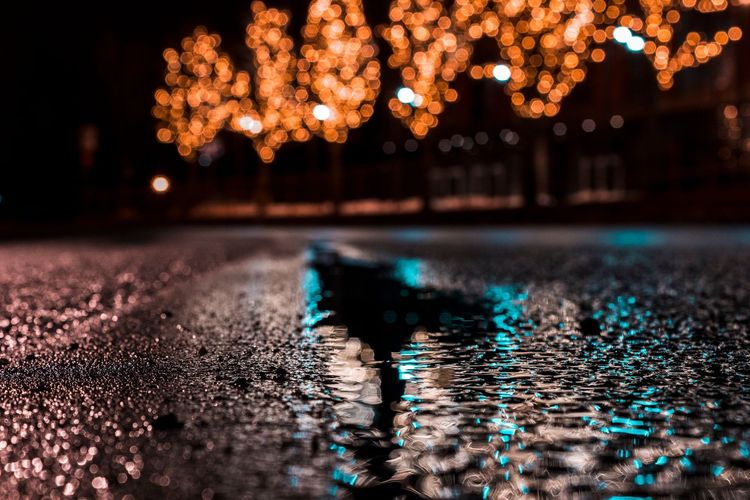
A rainy street at night can look almost theatrical. The pavement glows, headlights stretch into long ribbons, traffic signals smear into color, and ordinary sidewalks suddenly look polished. The street did not become brighter by itself. Water changed how the surface handles light.
The effect is familiar because it happens in cities, parking lots, garden paths, and driveways. A dry rough surface scatters light in many directions. A wet surface can become smoother in optical terms, creating stronger reflections and sharper contrast.
Pavement is rough even when it looks flat
Dry pavement is full of tiny peaks, pits, stones, cracks, and dust. When light hits that uneven surface, it scatters. Some light bounces toward your eyes, but much of it goes in other directions. The result can look dull or matte.
Water fills many of the small gaps. It does not make the road physically smooth like glass, but it changes the surface enough that reflections become more organized. Lamps and headlights can bounce toward you in more noticeable streaks.
Reflection is not the same everywhere
A puddle reflects like a small mirror because its surface is relatively smooth. Wet asphalt reflects less perfectly because stones and texture remain. That is why rainy streets show broken, stretched reflections rather than clean mirror images.
The angle matters. A light low in your view may reflect strongly along the pavement. A light directly above you may not create the same effect. This is why wet streets often look most dramatic when seen from a low angle down a road.
Darkness makes the glow easier to notice
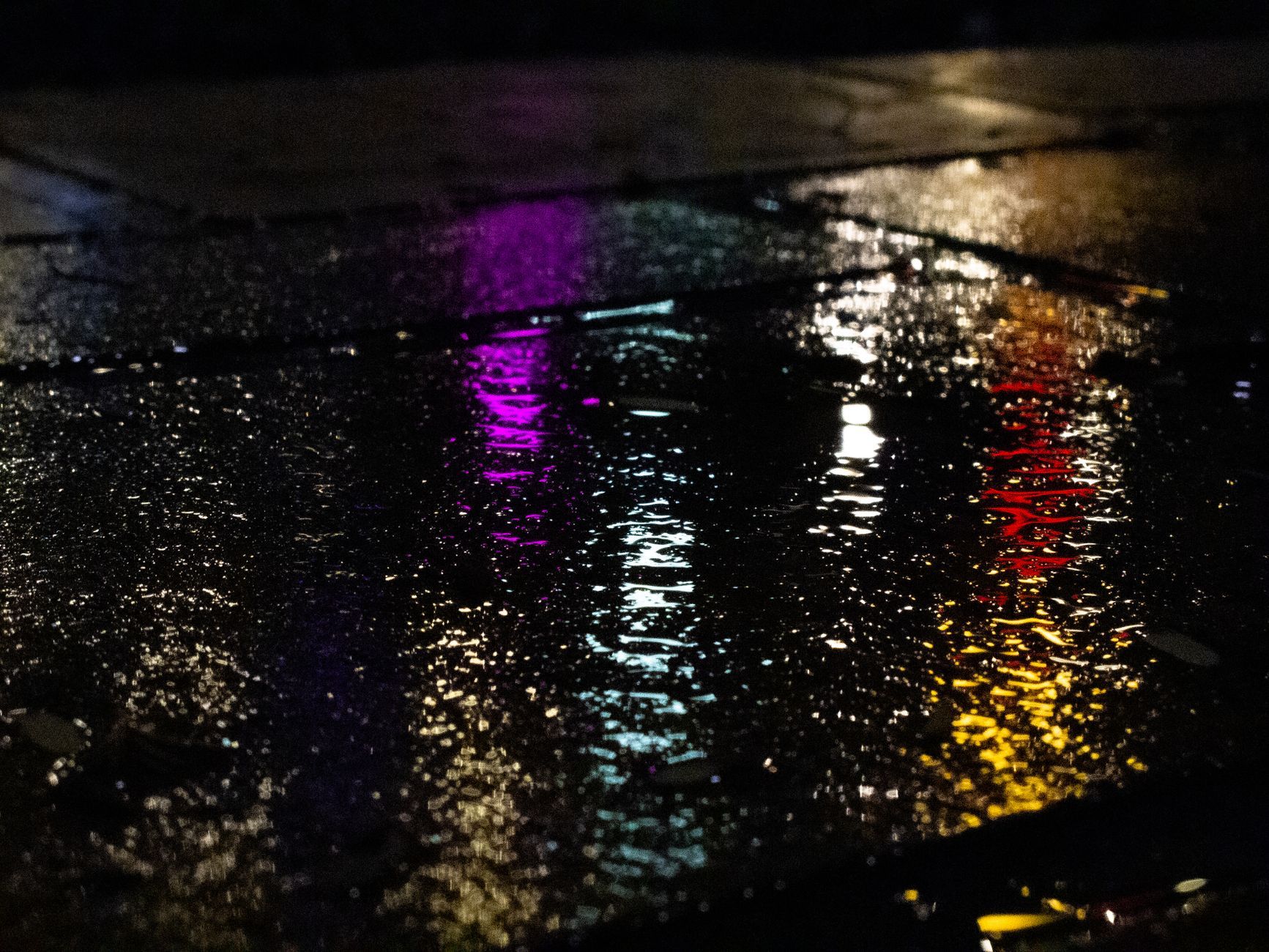
At night, the background is darker. That increases contrast. A small amount of reflected light stands out because the surrounding scene has less daylight competing with it.
The same wet pavement may not look as magical at noon. There is plenty of light everywhere, so the reflection is less visually dominant. Night turns the pavement into a screen for street lamps, signs, windows, and headlights.
Water changes color too
Wet surfaces often look darker in daylight because water reduces scattered light from the surface and lets more light enter the material before bouncing back. At night, that darker base can make reflected lights look stronger. The surface itself may look blacker while the reflected lamp looks brighter.
This is the contrast that photographers often use. A dark wet street and a bright neon sign create a dramatic pair.
A simple observation test
You can see the principle safely on a small scale. Compare a dry stone, a damp stone, and a stone with a small film of water under a lamp. The damp surface usually looks darker from some angles and shinier from others. Move your head and the highlight moves.
This is not because the stone learned a trick. It is because water changed how light travels across tiny surface has.
Why headlights stretch into lines
Headlight streaks on a wet road are shaped by surface texture, angle, motion, and the long viewing path along the ground. You are not seeing one perfect reflection. You are seeing many small reflections lined up across an uneven wet surface.
The result can look beautiful in a photograph and distracting in real driving. The visual effect is the same reason wet-night visibility can be challenging. Reflected light can obscure lane markings, potholes, or pedestrians.
Street design changes the effect
Different pavement materials reflect differently. Smooth stone, worn asphalt, brick, concrete, painted markings, and metal utility covers all respond to rain in their own ways. Newer road surfaces may behave differently from polished older ones.
Lighting design also matters. A warm street lamp creates a different mood from a white LED. Neon signs, shop windows, and traffic lights add color. A rainy street is a collaboration between water, surface, and city lighting.
Why artists and filmmakers love wet streets
Wet streets are popular in films and photography because they add visual depth. Reflections fill dark foregrounds. Colors repeat. The ground stops being empty black space and becomes part of the composition.
Sometimes crews wet a street even when the story does not require rain because the reflection improves the scene. The pavement becomes a quiet light source.
The ordinary science under the glow
The glow of wet pavement is a small lesson in optics. Surface texture, reflection, scattering, contrast, and viewing angle all meet in a scene people recognize instantly.
That is the pleasure of everyday science. You do not need a laboratory to notice it. You only need a lamp, a surface, a little water, and the habit of asking why the street suddenly looks alive.
Rough reflection in plain language
A mirror gives a clear reflection because its surface is smooth at the scale that matters for visible light. Pavement is different. It is a rough mix of stone, binder, dust, paint, cracks, and water. When rain fills the roughness, some parts become more mirror-like, while other parts still scatter light.
That mixed behavior is why wet pavement has both glow and blur. You see bright streaks, but not a perfect copy of the lamp.
Paint and road markings behave differently
White and yellow road markings can look especially bright when wet because they already have reflective materials and high contrast. But in heavy rain, markings may also become harder to distinguish if reflected glare spreads across the surface.
This is one reason road visibility is a design problem as well as a physics problem. Materials, maintenance, lighting, drainage, and driver angle all influence what people can see.
Small puddles act like temporary lenses
A shallow puddle can reflect a traffic signal sharply from one angle and almost disappear from another. Move a few steps and the reflection changes. The puddle is not moving much; your viewing angle is.
This makes rainy streets feel animated. Every step changes the geometry between eye, lamp, water, and surface.
Why photos exaggerate the beauty
Cameras often make wet-night streets look more dramatic than human vision because exposure settings, lens flare, long shutter speeds, and editing can stretch highlights. A photographer may choose a low viewpoint so the reflection occupies more of the frame.
The effect is real, but the image may emphasize it. That is why a rainy street in a film can look richer than the same street when you are simply trying to cross it.
A careful takeaway
Wet pavement glows because water reorganizes light on a rough surface, not because the ground is producing light. The street is borrowing brightness from lamps, signs, windows, and headlights. Rain gives those light sources a second surface to appear on.
What changes after the rain stops
As pavement dries, the glowing effect fades unevenly. Raised areas dry first. Depressions, cracks, and shaded patches hold water longer. This creates a patchwork of matte and reflective zones. You can sometimes read the shape of the surface by watching which areas keep reflecting light.
That drying pattern is useful visually because it reveals texture that daylight may hide. A road that looked smooth in sunshine can show dips and worn areas after rain.
The role of color temperature
Not all street lights create the same wet-street look. Warm lamps can make pavement appear amber or bronze. Cooler white lights can make reflections look sharper and more clinical. Colored signs add red, green, and blue highlights that repeat across puddles.
This is why two rainy streets can feel different even under the same weather. The surface is part of the effect, but the lighting design gives the scene its color.
A small caution about beauty
The glow is attractive, but it can hide hazards. Reflected headlights may reduce contrast. Wet leaves, painted lines, metal covers, and smooth stone can become slippery. The science that makes the street beautiful can also make it harder to read quickly.
That contrast is part of the fascination. Wet pavement is both a visual pleasure and a reminder that surfaces behave differently when conditions change.
Try a safe tabletop version
You can test the idea without standing in traffic. Place a rough dark tile, stone, or piece of matte cardboard under a lamp. Look at it dry, then add a thin film of water. Move your head slowly from side to side. The highlight should shift and strengthen at some angles.
Do not use electronics near water, and do not test on a road. The point is simply to see how water changes reflection on a rough surface.
Useful terms in plain English
Diffuse reflection means light scatters in many directions from a rough surface. Specular reflection means light bounces in a more organized direction, closer to a mirror. Wet pavement can move a surface slightly from diffuse toward specular, while still staying rough enough to blur the image.
The Exploratorium and university physics explainers often use simple light experiments to show reflection and scattering. The same principles appear outside after rain.
A specific city example
Think about a rainy crosswalk under white LED streetlights. The painted stripes, dark asphalt, metal drain covers, and puddles each reflect differently. The stripe may look bright, the asphalt may turn glossy black, and the drain cover may flash sharply. One street contains several surfaces, so the rain creates several kinds of shine at once.