The Quiet History Hidden in Everyday Desk Objects
A curious-culture tour of ordinary desk objects and the work habits, materials, and social changes they quietly reveal.
Start with the object, habit or tradition, then follow the context that makes it interesting.
The Quiet History Hidden in Everyday Desk Objects
A desk looks ordinary because it is close to us. We stop seeing the paper clips, keyboard, mug, lamp, charging cable, calendar, sticky notes, and notebook as historical objects. Yet a desk is a small museum of work habits. It shows how people store memory, mark time, manage attention, move information, and make private routines inside larger systems.
This article is a cultural explainer, not an archival claim about every object in every country. Object histories vary by manufacturer, region, and era. For readers who want primary materials, the Library of Congress collections are a useful entry point into work, design, advertising, and everyday documentation: <a href=“https://www.loc.gov/collections/”>Library of Congress digital collections</a>.
The paper clip: a tiny promise of reversibility
The paper clip is easy to overlook because it does one job quietly. Its cultural importance is that it joins papers without making a permanent mark. A staple says the pages belong together until someone removes metal by force. Glue says the join may be final. A paper clip says the relationship is useful but temporary.
That small difference matters in offices, schools, and homes. Temporary grouping supports drafts, forms, receipts, claims, and decisions that are not ready to be fixed. The paper clip belongs to a culture of review. It assumes documents will move, be checked, rearranged, and maybe separated again.
Sticky notes and the external mind
Sticky notes reveal something about attention. People use them because memory is unreliable and because a note placed in the right location can interrupt the future self at the right moment. A password should not be stuck to a monitor, but a reminder to bring a form, call a supplier, or water a plant works because the note lives where the next action happens.
The sticky note also shows the difference between information and placement. A digital reminder can contain the same words, but a paper note on a door handle uses space as part of the message. It is less a document than a small trap for attention.
The keyboard: a work tool that carries old assumptions
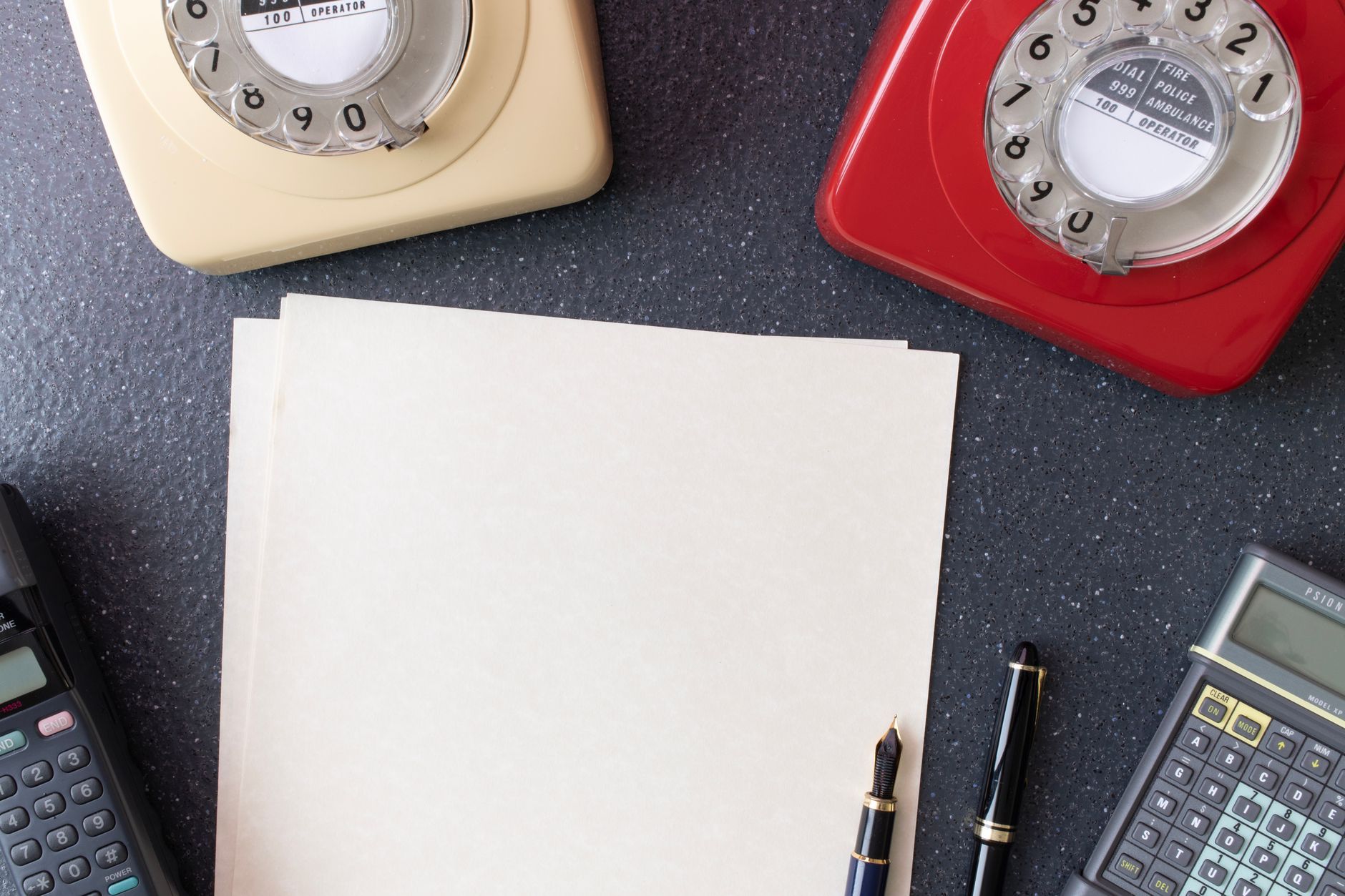
Modern keyboards connect to cloud documents, code editors, messages, games, and banking forms, yet their layout still carries older habits. The keyboard is a bridge between mechanical writing, office standardization, and digital life. It also shapes posture, speed, noise, and the boundary between thinking and producing.
A laptop keyboard says work can happen anywhere. A mechanical keyboard says the feel and sound of typing matter. A silent office keyboard says shared space has rules. The object is not neutral; it tells the body how work should feel and tells nearby people how much of that work they must hear.
Cable clutter as a map of transition
Cables are often treated as visual failure, but they reveal a transitional moment in technology. A desk may hold USB-C, Lightning, HDMI, Ethernet, audio, power bricks, adapters, and older device cables because standards change faster than households discard tools. Cable clutter is history arriving before old history has left.
It also shows how work became device-centered. A century ago, a desk might have been organized around paper flow, drawers, ink, lamps, and correspondence. A modern desk is organized around charging, syncing, display, and network access. The cable is not just a nuisance; it is evidence of dependency.
Mugs, bottles, and the domesticated office
A mug on a desk softens the boundary between home and work. It carries taste, routine, warmth, and pause into a space defined by tasks. In offices, personal mugs often mark belonging. In home offices, they can blur work and rest, especially when the same desk holds both invoices and a late-night cup of tea.
Water bottles tell a different story: the health-aware, mobile, self-monitoring worker. They imply hydration goals, commuting, gym bags, and long meetings. These objects are not dramatic, but they show how bodies remain present in spaces that pretend to be only about information.
The calendar: time made visible
A calendar turns time into a surface. Paper calendars show months at once and make deadlines physically visible. Digital calendars make time searchable, shareable, and interruptible. A desk calendar with handwritten notes has a different emotional texture from a shared calendar that can be edited by colleagues in another time zone.
The object matters because time management is not only personal discipline. It is social coordination. Meetings, school terms, medical appointments, subscription renewals, birthdays, and tax deadlines all compete for the same grid. A calendar is a quiet negotiation between individual intention and institutional time.
Lamps and the right to a personal pool of light
Desk lamps create a private zone within a larger room. A lamp says: this patch of surface is active. It can make a kitchen table into a study area or a bedroom corner into an office. The pool of light has emotional force because it separates focus from the rest of the room without building a wall.
Lamp design also follows changes in energy use, bulb technology, screen work, and aesthetics. A lamp that once served handwriting may now reduce eye strain beside a monitor or provide flattering light for video calls. The object adapts while keeping the same basic promise: make this small area usable.
What your desk says without trying
Try reading a desk like an archaeologist. Which objects store memory? Which manage time? Which connect to other people? Which keep the body comfortable? Which objects are old standards surviving beside new ones? The answers reveal not personality in a simplistic sense, but work culture in miniature.
A tidy desk and a messy desk can both be systems. The question is whether the person can find, remember, decide, and recover attention. Everyday objects become interesting when we stop asking whether they are impressive and start asking what problem they were invited to solve.
The charm of ordinary evidence
The desk is not a grand monument. That is why it is useful. It preserves small compromises between technology, habit, status, comfort, memory, and time. A paper clip, a note, a keyboard, a cable, a mug, a calendar, and a lamp can describe a century of work more quietly than a plaque. They are history that still has fingerprints on it.
Drawers and the private archive
A desk drawer is a small archive with low standards and deep meaning. It may hold spare keys, old badges, stamps, cables, receipts, pain relievers, foreign coins, batteries, and notes from projects that ended years ago. These objects survive because they are not important enough to file properly and not useless enough to throw away.
That middle category says a lot about modern life. People keep fragments of systems they might need again: a cable for an old camera, a receipt for a return window, a handwritten number with no context. The drawer becomes a storage place for uncertainty. It preserves the possibility that a forgotten object may suddenly become useful.
The notebook that refuses to disappear
Paper notebooks remain on digital desks because they solve problems screens do not always solve well. They open instantly, accept sketches, tolerate messy thought, and do not send notifications. A notebook can be private in a way a shared document is not, even when the ideas later move into digital form.
The notebook’s survival is not nostalgia alone. It shows that knowledge work still needs rough spaces. People need places where a thought can be incomplete without becoming searchable, shareable, or judged. The notebook is not the opposite of digital work. It is often the workshop behind it.
The wastebasket as an editing tool
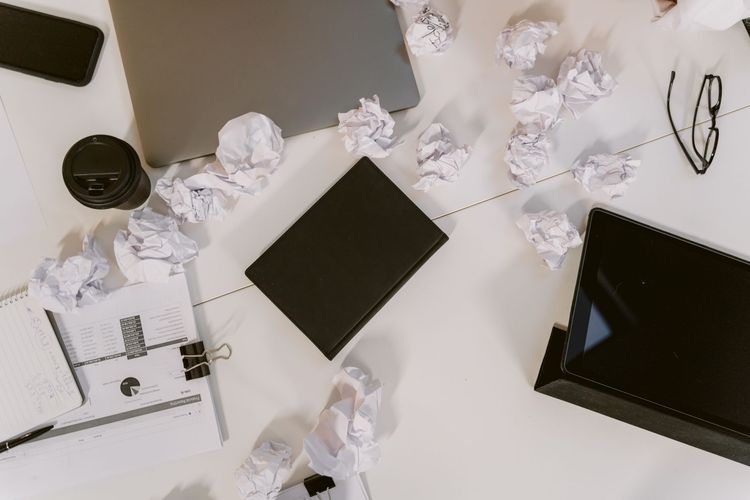
The wastebasket is the desk object that records decisions by removing evidence. Drafts, packaging, notes, envelopes, and broken pens pass through it when their usefulness ends. In that sense, it is part of thinking, not only cleaning. It marks the moment when a possibility is rejected or a task is complete.
Digital work has trash folders too, but they often feel less final because recovery is easy and storage is huge. A physical wastebasket gives deletion a visible volume. At the end of a busy day, it shows that work produced leftovers, not just finished files.