Pierced Shell Beads: Our Ancestors Loved Beauty Way Earlier Than We Ever Figured Out
Shell beads dug up across North Africa change everything we know about when humans started thinking abstractly. These pea-sized beads existed tens of thousands of years before the popular German ivory bird carvings, solid proof early humans mastered handcrafting, cross-tribe trading, clan totem culture and abstract logic way sooner than old academic theories claimed. Nomads wore these beads as daily protective charms long before cave paintings appeared, proving ancient people had sophisticated aesthetic tastes and complete social structures all along.
Translate the everyday question into simple mechanisms, limits and observable details.
I’m sure anyone endlessly scrolling archaeology reels has come across those tiny ivory bird carvings dug out from caves in Germany. Everyone’s obsessed with those Ice Age sculptures, can’t blame them really, they’re absolutely stunning. But how come nobody ever talks about those shell beads archaeologists keep digging up on three separate continents? They’re way older than the ivory birds, packed with tiny fun tidbits most short videos skip entirely. I’ve gone through excavation reports a handful of times lately, and honestly, every time I read new details I’m still blown away.
Each bead is just about the size of a pea, carved from super thin shell material that snaps right in half if you squeeze too hard. Some of these artifacts stretch back over 100,000 years, and man, it’s genuinely difficult to wrap your head around that stretch of time. I’m not here to dump walls of boring academic paragraphs on you today. Let’s just chat casually, run through all the cool little finds researchers have stumbled onto over the years.
Unconnected Ancient Tribes, Same Clever Bead-Making Skills
One fact caught me totally off guard when I first learned it: ancient groups living on completely different continents had zero contact with each other whatsoever, yet all of them independently worked out how to drill holes into shells to craft beads. Let’s start with Zhoukoudian in China. Dig teams there uncovered shell beads mixed together with animal teeth, dating back around 30,000 years. Back then, local residents drilled holes all the way through both sides of each shell piece.
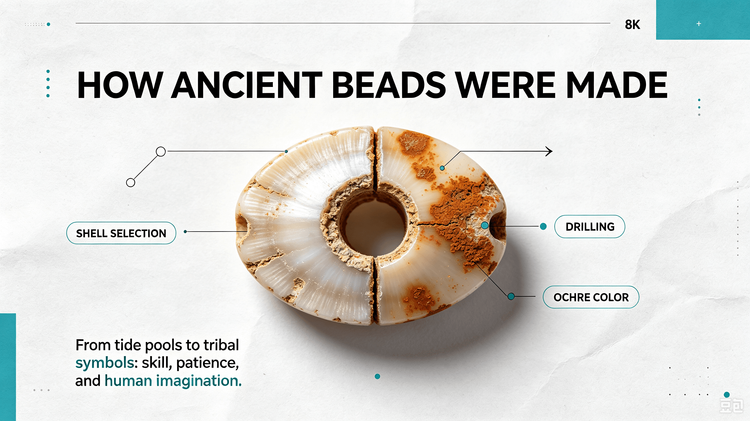
Head over to North African caves such as Bizmoune, and their crafting method is entirely different. They only bored into a single side of the shell instead. Inside that Moroccan cave mound lay piles of triangular shell beads older than 100 millennia, each with a neat little opening right at the pointed tip. Metal drills didn’t exist during that era, naturally. People sharpened animal bones and thin stone fragments, grinding holes slowly and laboriously. I won’t walk you through every single messy crafting step, the whole process was exhausting work carried out deep within shadowy, cold caves.
Slip these beads under a microscope, and faint smears of red ochre pigment show up across most surfaces. After drilling each shell open, folks would rub that mineral pigment across the beads just for a subtle splash of colour. Collecting usable shells wasn’t easy either. The shellfish they relied on only grew in shallow coastal pools, miles away from the inland caves where these tribes made their homes. Groups would hike all the way down to the shore, toss misshapen, fragile shells straight onto the beach on the spot, then haul only the intact, pretty shells back to dark, damp caves to work with.
Every waking moment for these ancient people was mostly spent hunting and gathering food just to survive. Even with barely any spare time, they still set aside precious hours to make shell beads. These trinkets couldn’t feed hungry tribe members, couldn’t chase off wild predators lingering near camp either. Certain people within each clan spent most of their days crafting beads for the whole community, and that detail alone makes it obvious how meaningful these tiny objects were to their everyday lives.
Tens of thousands of years ago, workers unearthed massive batches of well-made shell beads inside South Africa’s Blombos Cave. You can clearly tell their crafting skills refined generation after generation. They drilled holes in the exact same spot on every bead, and buried big piles of finished beads together once production wrapped up. It’s clear they made dozens in one go to pass around everyone in the tribe. Sometimes I daydream about what casual conversations sounded like when they handed these beads to their neighbours all those years ago.
Most people automatically assume these miniature shell beads were toys for ancient kids, but that’s such a wrong assumption. Nomadic clans only had between twenty and fifty people each, and disputes over clean drinking water and prime hunting land popped up constantly. There were no flags, no written language to mark which clan someone belonged to, so shell beads became a quick visual marker of tribal identity instead.
Every clan stuck firmly to one specific shell type to create their beads. South African communities used one distinct species of sea shell, North African clans favoured triangular shells, and the people living near Zhoukoudian combined sea shell beads alongside animal teeth. Excavation sites rarely ever uncover matching shell varieties, meaning clans maintained clear cultural divides between one another.
Spiritual Meaning and the World’s Earliest Tribal Trade
These beads carried spiritual weight too, and they even gave rise to the earliest forms of tribal trade.
I was flipping through old excavation logs a while back and found a really upsetting burial discovery. In one South African cave, archaeologists found an infant’s skeleton buried alongside shell beads. This ranks as humanity’s oldest case of jewelry being interred with the deceased. Ordinary people wore shell beads every single day, strung onto necklaces and wristbands. They firmly believed these beads held protective power originating from the ocean, able to scare away wild animals and even warn them of incoming bad storms.
Massive ivory statues and cave murals stayed fixed in cave walls, only brought out for large group rituals every now and then. Shell beads travelled wherever their owners wandered: hunting trips, seasonal migrations, every journey you could name. They’re humanity’s first portable spiritual talismans, created long before those viral German ivory bird carvings popped into existence. It’s kind of silly how social media only hypes up those newer Ice Age sculptures, don’t you think?
Researchers stumbled onto another pleasant surprise: primitive trade routes formed far earlier than historians previously guessed. Deep inland caves, hundreds of kilometres away from any coastline, still hold perfectly intact sea shell beads. Inland hunters traded animal hides and sharp stone blades with coastal tribes to get their hands on these shells. Beads recovered from dig sites across Africa and China help piece together faint traces of these ancient trade paths. Early humans would regularly wander outside their familiar territories just to meet foreign groups and swap goods.
Stone spears and axes existed solely to help humans survive harsh environments, yet shell beads served zero practical function at all. They were crafted purely for decoration, to signal tribal belonging, and for quiet spiritual customs. For decades, many scholars insisted early humans lacked the focus to observe and categorize wildlife carefully, but these shell beads completely dismantle that outdated viewpoint.
Our ancestors knew tidal rhythms like the back of their own hands. They headed down to beaches during low tide to gather shells safely, could instantly pick out shells suitable for carving, and tossed flawed specimens away without a second thought. Their basic understanding of marine life was genuinely impressive for such a primitive era.
How These Tiny Beads Rewrite Human History
Studying these African shell beads completely rewrote the academic understanding of human intellectual development. For the longest time, experts treated European Aurignacian cave art as the dividing line separating modern humans from Neanderthals. Neanderthals occupied large swathes of Eurasia for hundreds of thousands of years, yet they only ever fashioned simple stone tools. They never created symbolic shell beads or wearable spiritual jewelry of any kind.
Modern humans crafted meaningful shell beads more than a hundred thousand years before those famous European Ice Age statues were carved in Europe. Making these beads demanded abstract reasoning capabilities Neanderthals simply never evolved. You have to plan lengthy tasks that offer no immediate food reward, assign personal and tribal meaning to an ordinary shell fragment, produce matching beads for dozens of clan members, and rely on beads to build social connections through trade and burial traditions. All that abstract thought allowed our ancestors to survive brutal ice ages and spread across every continent on the globe.
If you ever get the chance to visit museums that preserve these ancient beads, do not skip the joint exhibit named Ocean Treasures. Morocco’s national museum, Cape Town’s human origins museum, and the Zhoukoudian Site Museum showcase these beads all year long. Grab a magnifying glass from the display counter if they have them available. Tiny grinding scratches line the hole of every bead, worn silky smooth after thousands of years pressed against human skin. Seeing that tiny subtle detail in person is such a gentle, moving experience.
When humans first began crafting these shell beads, writing systems didn’t exist, there was no formal tribal leadership organising communities either. All they had were rough bone awls and shells hauled over endless miles from coastal shores. Every tiny bead encapsulated hopes for their clan’s future, curiosity about distant unknown seas, and that innate human fondness for beauty. Honestly, I could stand in front of those museum display cases for hours just staring quietly.
At the end of the day, tool-making skills aren’t what separate humans from every other animal alive. We stand apart because we willingly waste hours making tiny, useless yet beautiful little things to carry our identity and beliefs. Those shell beads washing onto African shorelines more than a hundred millennia ago sparked humanity’s first genuine curiosity, and our endless chase for beauty ever since.