Hidden in Tiny Ivory Sculptures: The Untold Spiritual World of Early Humans 40,000 Years Ago
Start with one concrete detail, then connect it to the wider story without losing the reader.
Forty thousand years ago, Europe was a frozen, unforgiving landscape trapped in the grip of the last major ice age. The first groups of modern humans to settle here struggled endlessly against freezing temperatures, spending every day hunting mammoths and reindeer just to keep their communities alive. What modern researchers didn’t expect to find, though, was that these prehistoric survivors were far more than mere hunter-gatherers. Even amid constant survival pressure, they nurtured a delicate, profound creativity, crafting tiny art pieces that rewrite our understanding of early human evolution.
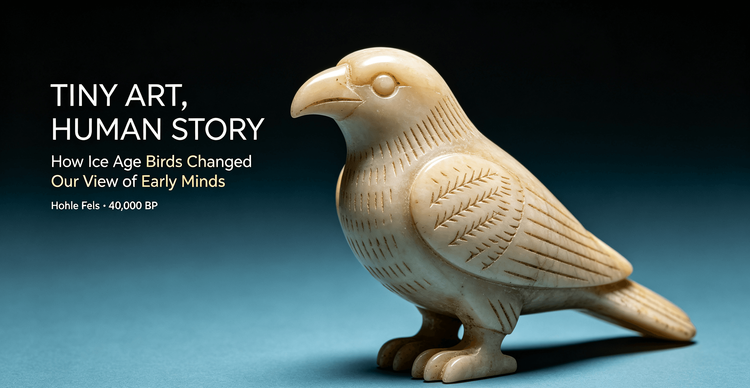
In 2025, a research team from the University of Tübingen made a groundbreaking find at Hohle Fels Cave, a world-famous prehistoric site in Germany’s Swabian Jura region. Buried deep within 40,000-year-old cultural sediments were two miniature bird figurines carved from mammoth ivory. These minuscule artifacts have forced academia to rethink long-held assumptions about how skilled, observant, and spiritually aware early modern humans truly were. Unlike standard archaeological write-ups that fixate rigidly on excavation procedures and technical data, I want to unpack the real stories behind these tiny sculptures. At less than 2.5 centimeters long and under 1.5 grams in weight, they look insignificant at first glance, yet they hold four key clues to early human craftsmanship, natural wisdom, tribal culture, and cognitive growth.
1. Unmatched Miniature Craftsmanship in the Ice Age
Nearly all Ice Age artworks recovered from the Swabian area fall between 2.5 and 10 centimeters in length. These two newly discovered bird carvings are the smallest representational pieces ever found at the entire site. Anyone who tries to imagine creating art on this scale 40,000 years ago will quickly grasp how impressive this achievement really was.
The artisans worked with mammoth ivory, a material that’s deceptively tough yet extremely prone to cracking and shattering. With no metal tools whatsoever, they relied solely on sharp flint shards and simple bone scrapers to shape every detail. Microscopic analysis of the sculptures reveals incredibly refined, consistent incisions across the entire surface—no messy trial marks, no random scratches. One bird features distinct layered feather textures, clear eye sockets and a sharp, well-defined beak. The other is sculpted in a resting posture, with a rounded belly that perfectly mimics a brooding bird. Every single cut serves a clear purpose, with no redundant lines or wasted effort.
Producing these pieces was a meticulous, multi-stage process that demanded incredible patience and skill. Workers first trimmed thin ivory strips and soaked them in water to soften the brittle material and prevent breakage. They then polished the raw ivory repeatedly to form a basic outline, carved fine details with tiny flint blades, and finished each piece by buffing the surface with animal hides. All of this work took place in the dim, flickering light of cave fires, with no stable lighting to aid their vision.
Maintaining steady hands and precise focus for such detailed work strongly suggests specialized artisans existed within these early human communities. What’s more, the two carvings share identical carving pressure, line thickness, and stylistic traits. Discovered just 1.5 meters apart in the same sediment layer, they were almost certainly a paired set, handmade by one single skilled craftsperson.
2. Precise Wildlife Knowledge Hidden in Simple Carvings
For decades, anthropologists believed Paleolithic humans only observed animals in the most basic, superficial way. The general consensus was that prehistoric carvings were rough, generic sketches, with no attention to behavioral or anatomical detail. These two tiny bird sculptures completely dismantle that outdated view.
After cross-checking the carvings against Ice Age ecological records, researchers confirmed the models are almost certainly rock ptarmigans. These grouse birds thrived in the tundra and low shrub landscapes of southern Germany during the glacial period, making them a common sight for local human groups. Early hunters would have watched these birds closely throughout the year: they molted into white winter plumage to blend into snow cover, nested on the ground each spring and summer, and traveled through short, low glides while foraging.
The artisan didn’t just copy a quick glimpse of a bird. Instead, they captured two completely opposite life states with remarkable accuracy. One carving, slightly damaged over millennia, freezes the dynamic motion of a bird mid-glide, wings fully extended as it lands. The other intact piece depicts a quiet, stationary scene: a parent bird settled on its nest, rounded belly signaling incubation. The sharp contrast between movement and stillness makes it obvious the creator observed these birds consistently across all seasons, compiling a full understanding of their behavior before condensing those observations into miniature art.
This isn’t the first ancient bird carving found at Hohle Fels Cave. Back in 2001, archaeologists uncovered a 5-centimeter ivory water bird, still recognized as the oldest representational bird artwork ever discovered. The fact that three bird-focused carvings have emerged from this single cave—while all neighboring contemporary sites only produce carvings of mammals like lions, horses and mammoths—proves this specific tribal group had a unique, sustained fascination with birds.
3. Miniature Amulets: Tribal Identity and Spiritual Blessings
It’s tempting to write these tiny sculptures off as primitive children’s toys, but modern cross-field archaeological research has thoroughly debunked this casual assumption. As Daniel Adler, a leading scholar of Upper Paleolithic culture at the University of Connecticut, points out, these portable micro-carvings were never created for entertainment. They served as wearable identity markers for tribal groups and personal spiritual talismans for individual hunters.
Early modern humans lived in small, mobile bands of 20 to 50 members. Competition for resources was fierce, and inter-tribal conflicts were frequent, creating a critical need for unique symbols to distinguish allies from rivals. Lightweight and compact, these bird carvings could be strung on necklaces or sewn onto fur clothing, making them easy to carry during migration and hunting trips.
In prehistoric belief systems, birds carried powerful symbolic meaning. Linked to the open sky, seasonal migration and natural reproduction, they stood for survival, renewal and continuity. The flying bird represented safe passage for hunters traveling far from camp, while the nesting bird symbolized growing populations and stable tribal life. Researchers have two core theories about their usage: they may have acted as personal protective charms, believed to grant humans the bird’s sharp senses to evade predators and anticipate harsh weather. Alternatively, they likely served as exclusive tribal totems, setting this community apart from neighboring groups.
This sets the bird carvings apart from large stone and ivory statues placed in fixed cave ritual zones. Those grand artworks were built for communal worship, while these tiny pieces traveled with people everywhere. As the earliest portable spiritual artifacts in human history, they offer clear proof that early modern humans had already built a mature, structured system of symbolic faith.
4. How This Tiny Art Proves Humanity’s Cognitive Revolution
The period around 40,000 years ago marked a defining turning point in human history. Modern humans were expanding rapidly across Europe after migrating out of Africa, while Neanderthal populations slowly declined and disappeared. The rise of Aurignacian culture has long been seen as the mental dividing line between modern humans and archaic hominins, and these delicate ivory bird carvings stand as some of the most convincing physical evidence for this cognitive leap.
Creating artwork this refined and lifelike requires far more than basic hand-eye coordination. It relies on a suite of advanced cognitive skills that Neanderthals simply never developed. First, the artisans could construct complete, vivid mental images of animals, recalling both dynamic movement and static poses to create art from memory, without a live reference. Second, they mastered extreme fine motor control, executing precise millimeter-level adjustments with nothing but crude stone tools.
Most importantly, these early humans possessed abstract thinking abilities. They didn’t just carve a bird as a physical object—they infused it with layered meaning: protection, tribal identity, hope for survival and generational renewal. The entire production process, from harvesting and treating raw ivory to meticulous carving and final polishing, also demonstrates long-term planning and sustained patience, traits absent in archaic human toolmaking.
Neanderthals survived in Eurasia for hundreds of thousands of years, yet their toolkits remained simple and functional, with no symbolic or artistic creation. This stark gap explains why modern humans thrived and expanded in the brutal Ice Age environment, while other hominin species faded away. Our ancestors’ ability to create art, think abstractly, and build spiritual belief systems was their greatest survival advantage.
The research team led by Nicholas Conard continues to advance related studies. They are now extracting ancient DNA from cave sediment samples, hoping to reconstruct the local Ice Age ecosystem and ancient prey species. Their ongoing work aims to clarify the full connection between this bird totem tradition and the daily survival patterns of early tribal communities.
5. A 40,000-Year Dialogue Between Past and Present
Today, these two extraordinary Ice Age bird carvings are officially exhibited at the Prehistoric Museum in Blaubeuren, Germany. Featured in the special exhibition Light as Feathers, Heavy with Civilization: Miniature Bird Carvings of the Ice Age, they will remain on public display through April 2027.
Visitors peering through magnifying glasses can observe every tiny incision left by an unknown artisan 40,000 years ago. Long before written language, recorded history or complex social systems existed, Ice Age humans used simple flint tools and raw mammoth ivory to preserve their understanding of nature, their wishes for their people, and their unyielding will to survive.
These unassuming miniature sculptures carry a profound truth about humanity. What separates us from all other life on Earth is not merely our ability to manufacture tools. It is our innate capacity to create beauty, assign meaning to the world around us, and hold spiritual hope even in the harshest conditions. Forty thousand years ago, on the frozen plains of Ice Age Europe, our ancestors had already awakened this uniquely human power.